

 |
 |
 |
 |
 |
 1935
1935
Vincenzo Balsamo was born on the 27th of June in Brindisi.
1946
The second of seven children, he loses his father, a sailor, following a work accident. This event plunges the family into economic
ruin forcing Balsamo to leave his studies and look for work. He finds employment as an assistant in the artisan studio of the painter
and decorator Pietro Acquaviva. Thanks to a number of jobs within local churches, Balsamo quickly gains a strong feel for
retouching, he learns to recognise primary and secondary colours and all that is central to the pictorial medium; pigments, coloured
ochres etc. This becomes of fundamental importance for his artistic future. Thanks to the maestro Acquaviva he discovers how a
painting is born. Thus he begins to compose his first artworks, copying postcards, painting floral subjects, country views and
houses.

1949
The economic condition of the family still does not improve. At the age of fourteen, Balsamo goes to live with an aunt in Rome.
These are the years of post war reconstruction and building sites are constantly on the lookout for labour. It is easy for Balsamo to
find work; but his spirit becomes more and more drawn to painting and thus he continues his artistic development.
1954
On the advice of a friend he enrols at the Scuola d'Arte San Giacomo in Rome where he will study for three consecutive years
and where he refines his drawing techniques. Painting has now become an integral part of his life. Balsamo completes portrait studies,
landscapes of intense vitality,
fascinating still lives, glimpses of
the suburbs, etc...
1957
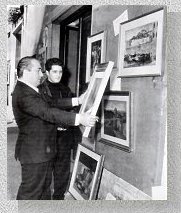
He holds his first public exhibition at the "Circolo Cittadino" in Brindisi dedicated to the maestro Acquaviva.
1959
He opens his first studio on Via Margutta, in Rome. Thanks to his friendship with Michele Calabrese, he begins to get to know the
great artists that live in the capital, in particular those who belonged to the Roman School; Mafai, Pirandello, Scipione, Afro, as well
as Omiccioli, Sante Monachesi, Guttuso, and many more painters as well as poets and writers like Alfonso Gatto, Sandro Penna
and PierPaolo Pasolini.
1960
In October he marries Lidia Tedesco.
1961
He exhibits for the first time in Rome at the "Il Camino" Gallery. He is also invited to curate among others, the creation of the
scenography for the film "Cleopatra" in the Cinecittà studios. This cinematographic experience is one he will pursue for a further
two years. His first child Roberto, is born.

1962
It is a year of travel in Italy as well as Europe. In the paintings of this time where the landscapes of Tuscany,
Umbria, Lazio or
Campania become intense and intimate, the pictorial technique, composed of vibrant brush strokes, revels in a play of fantastic
tonalities.
1963
The number of exhibitions multiply and the critics begin to discern in this young painter, not merely potential but a certainty for the
future. Mannoni, Del Massa, Omiccioli among others write about him, drawn by a painting style that combines a blend of
Mediterranean and Nordic culture. During this year he completes a series of works inspired by Jazz music, titled "I musicanti" (The
musicians) and exhibited with great success in America. He participates at the X Quadriennale (Tenth Quadrennial) in Rome.
1964
The works of Balsamo enter an expressive more complex phase where the colors of the blue, of the red, of the greens, of the
yellow etc., they amalgamate like inspired from a controversial intimacy, at times suffered also. He knows and establish a
relationship of collaboration with the "Bürdeke" Gallery of Zurigo. He becomes a father for the second time, his son Francesco is born.
 |
Top |
1965
On his frequent travels abroad, on one occasion accompanied by Michele Calabrese, on another by Alfonso Gatto he has the
opportunity to visit numerous museums. Among these the "Kunstmuseum" in Zurich and Basel, Switzerland. The works on exhibit
by great masters leave an indelible impression on the artist. He exhibits in Zurich at the "Bürdeke" Gallery.
1966
In Saint Paul de Vence he gets to know André Verdet, Arman e César; in Paris he meets Picasso and Hartung and follows Léger at
the Gran Palais. These encounters lead him to develop a clear idea of modern art in Europe. He begins to perceive his landscapes
under a new light. The coloured backgrounds are deconstructed even further becoming almost abstracted. It is an evolutionary
process that only subsequently in the 1970s will see the final transformation of the artist's expressive practice.
1967/68
The landscapes or the still lives become evermore fragmented and the perspective planes interlace, disarticulating the image.
Balsamo becomes father for the third time with the birth of Antonella.

1970/73
The artist is now propelled towards a new representational form. He turns his research towards Cubism, attracted by an ever-
greater synthesis. The perspective planes, the volumes, the objects intertwine and almost dismember, though without losing
homogeneity and colour.
1974
Balsamo becomes more and more focussed on synthesis, shifting his gaze towards an almost geometric Abstraction. He returns to
the coloured backgrounds that he had left following his landscapes of the 1960s, these are now without a hint of figuration and are
separated by a black mark, which becomes the thread of memory. Daniela, his youngest child is born.
1975
During this year and throughout the next, Balsamo completes the "Decomposizioni" (Decompositions), works that move away from
anything he has painted thus far. These works are informal, material, full bodied, harsh in their pictorial expression.
1977
From this time until the end of the decade are years of clear research and experimentation. Balsamo at this time, shifts his focus
towards the gestural mark. He completes paintings titled "Nebulose" (Nebulas), which are not envisaged as a celestial world, but a
mental and internal journey in search of the just balance between the gestural mark alongside and upon colour.
1978
The artist enters a new expressive phase, complex, difficult and introspective. The works titled
"Evocazioni" (Evocations) are
completed. Not finding within himself what he was searching for, he paints with the use of an aerograph, strangely deformed, surreal
and fantastic figures, symptoms of weariness and doubt. From this moment and for the following ten years, he refuses to exhibit.
Today, without abashment, he admits to the thought that afflicted him at that time; that of abandoning painting.
1980/85
He moves to Velletri with his family and he transfers his studio to Via Laurina, a few steps from Piazza del Popolo. From this time
he strives to regain his expressive thought, he spends his time at his easel to rediscover a new more congenial world. Past memories
come flooding back to him, like memory icons. He paints works linked to a abstract-cubist concept. Two serious family events
mark Balsamo's private life. Two brothers are involved in a car accident: one loses his life and the other survives, but only after
many months will he return to his former self.
1987
Balsamo, having found the strength to emerge form an unfortunate private time, is propelled towards a decisive shift in his pictorial
activity. In these new canvasses, many of large dimensions, the gestural mark has become meticulous, complex and with a strong
lyrical and surreal reference. After
over thirty years of harsh experimental works and sacrifice, he has finally found his personal
concrete and essential world. The exhibitions become again more frequent and the critics rediscover his work
in all its strength.
1989
It is the year of the definitive comeback. Firstly in Rome, at the "MR" Gallery, and then at international collectionism level with
exhibitions at the Art Fair in Bologna, Hamburg and Nice.
 1989. In the studio of Via Laurina |  1989. solo show at the "International Forum" in Hamburg. | Top |
1990
A major exhibition is held at the "Santa Apollonia" Art Centre in Venice. Curated by Vito Apuleto it brings together all the
work of these last years under the title of "Sintesia" (Synthesis). His artistic practice enters his most creative period. Balsamo abandons
a certain affectedness and dedicates himself primarily to the essence and integration of his concepts.
1991
He separates from his wife and moves to Paris with his new partner. He opens a new studio in the French capital. The glamour of
this city overwhelms him passionately. He paints unique works as part of this artistic journey. The solo and group
exhibitions increasingly follow in succession.
 |
 |
Tardia, Ala, La Barbera and Torti. |
at the Gradiva Gallery in Rome. |
1992
He spends a few months in Sicily, becoming fascinated with the colours, the light and atmospheric moods of that land.
1994
He spends his time between Italy and Paris. Two important and prestigious solo exhibitions take place in the French capital, the first
at "Découvertes" in Porte de Versailles and then at the "Lansberg" Gallery on the Rue de Sein.
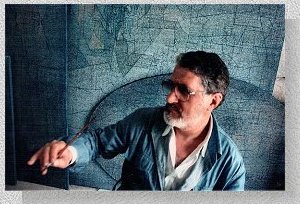
 Balsamo at his easel. |
1995
He maintains the Parisian studio while moving to Treviso.(Italy) He shows the works from the Paris exhibitions at the
"ValenteArteContemporanea" Gallery. It is an important year in the terms of his personal life, with his new partner he becomes a
father once more. The passion for painting is nourished by this dawning "light" and the hours spent at the easel seems to never be
enough.
1996
He also opens a studio in Verona. An anthological survey exhibition curated by Floriano De Santi begins at the "Forte Spagnolo" in
Aquila and will tour to four other public locations in Italy. After the Abruzzi capital it reaches the Centro Internazionale "U.
Mastroianni" in Arpino.
1997
After the venues in Rome at the "Accademia d'Egitto" and Ravenna at the "Centro Polivalente", the anthological survey completes
its tour at the "Palazzo Ducale" in Mantova.
1998
An important solo exhibition is mounted at the "Fontana Gallery" in Spoleto as part of the Festival of the Two Worlds.

 |
 |
| Enter at San Marco Gallery | Exhibition detail |
1999
The abstracted backgrounds become even more fragmented. The wedge shapes, representations of an essential memory, illustrate
the summary of a journey that had begun over ten years before. He is involved with two major exhibitions outside Italy: the first in
the United States in Atlanta at the "San Marco" Gallery and the second in Paris at the "Carousel du Louvre". He leaves his
Paris studio, inaugurating a new one in Verona.
 2000. Balsamo (in center) at opening of his exhibition at Melotti Art Studio |
Top |
2000
Professor Granzotto curates a monograph launched this year. The almost two hundred works reproduced comprise the artist's
latest painting cycle. Balsamo senses the maturing of two fundamental and concrete impulses; one leading toward the mental
summary of everyday life through a kind of "presences"; the other turning toward a search for an even more
essential synthesis,
where colour becomes purely monochrome.
2001
Following the exhibitions that kept him occupied firstly in Torino, with the launch of a catalogue curated by the critic Gian Giorgio
Massara and with the solo exhibition at the European Parliamentary Palace in Bruxelles; Balsamo again crosses national borders for
an important exhibition at "Nagahama Museum", Japan.
 Balsamo at the inauguration of the exhibition in Nagahama |
 Balsamo donates one of his artworks to the Nagahama Museum |
2002
Balsamo returns to Italy with a one-man exhibition at the "ValenteArteContemporanea" Gallery where he exhibited seven years
previously, and simultaneously he shows in Antologica at the "Chiostri di S. Caterina" with a catalogue curated by Marisa Vescovo.
The year 2002 is possibly also a year of change; the artist avows the desire to close this last cycle of "Lyrical Abstraction" to
dedicate himself to a new expressive phase in his work, a more synthetic approach where the gestural mark becomes the signifier
for space-time.
In this year there is also the opening, by Vincenzo Balsamo, of his personal and official website at: www.vincenzobalsamo.com

 |
 |
| Balsamo between the Critic Marisa Vescovo and the Responsible for a Cultural Department of Finale Ligure City |
A part of exhibition at Chiostri in the Hall of the Archs |
2003
After the fine art exhibition, done in the month of Fabruary, at Pont-Aven Gallery of Suzzara, Vincenzo Balsamo renunces at the exhibitions for devote entirely to
the job. Going on, from the previous year, the search toward a new abstraction.
He opens a new studio at Corchiano, a small city situated on the nice viterbesi hills.
The 2003 is also an year of important acknowledgment. He has nominated as Artist of the Year by:
"World Art Celebrities Journal and Humanities Committee - SPECIAL EDITION INTERNATIONAL 2003 YEARBOOK",
"The Readers of the World Art Celebrities Journal - The International Center For The Study Of Progressive Neo Cubism"
Balsamo, besides, has selected by Richard Wheeler, a student of the University of Kent (Canterbury), for an important Contemporary Art Project. Project finished with a fine interactive CD by the title:
"The interactive gallery of Vincenzo Balsamo's work".
The year is close with 2 exhibitions in contemporary at Viterbo; one at Miralli Gallery, with the works on paper, other at Chigi Palace with the works on canvas.
For this event come also edited, by the Critic Ernesto d'Orsi, a catalogue, in Limited Edition, with a Print by etching coloured in watercolour by Balsamo.
2004
2004 has been for Vincenzo Balsamo a very intensive year as he planned and run a great number of important exhibitions which, during 2005, will be held in Public Spaces and Galleries all around Italy.
At the end of the year Balsamo stayed for a pretty long period in Australia where his son Roberto lives and works. In that opportunity the Greg James Studio Gallery of Fremantle (Perth) host a personal exhibition dedicated to his works on paper.
 |
| Balsamo, with his son Roberto, at opening of his exhibition at Greg James Studio Gallery of Fremantle (Perth) |
2005
1955-2005 - "The Odyssey of the light and color", this is the title of the retrospective exhibition at Archivio di Stato of Turin that celebrates
the fifty' years of Vincenzo Balsamo’s painting. For the event was also printed a catalogue (Ed. Vallecchi), curated by Prof. Floriano De Santi
and accompanied from a deposition of the Prof. Roman De La Calle director of the Valencia Museums. The catalogue, with more than
100 works reproduced, retraces the artistic career of Balsamo from its figurative debut since the last works of lyrical abstraction’s period..
Balsamo, together with Mimmo Rotella, is special guest at 13ª Montichiari Art Fair with an his Rectrospective Exhibition.

 |
 |
| The first part of exhibition | A part of exhibition |
2006
This year many opportunities of contact around the world. Also with
possibility to shown his works in the most important italian Art Fair like Bologna,
Verona, Padova, Viterbo, Rome, and international like Shangai.
2007
In 2007 Vincenzo Balsamo participated at the following international art fairs: Art Miami (FL - USA),
Artexpo NEW YORK (NY - USA) and KIAF (Seoul - South Korea).
He also exhibited in a solo show at the "Fondazione Luciana Matalon" in Milan, Italy; on that occasion was published
a new catalogue written by the curator Prof. Floriano De Santi.
The same year the artist begun a strong collaboration with MOdenArte Gallery where he had had the opportunity of setting
up a couple of important shows: the main, his first retrospective, was scheduled in October at the gallery located
in Modena; the second, in December, at the gallery in Iseo (Brescia). Both exhibitions were been curated by the art
critic Maurizio Vanni who wrote an important book printed by Carlo Cambi.
Moreover the Londoner Art Gallery HF Contemporary Art, directed by Helga Fox, displayed some Balsamo’s artworks at the "Viva Italia Show" and
at the European Commission of London.
 |
 |
| Balsamo at Viva Italia Show by HF Contemporary Art directed by Helga Fox in the foreground |
(Art Fair Innsbruck) In the foreground Helga Fox of HF Contemporary Art and the Balsamo's works in the background |
2008/09
Balsamo opens the year 2008 with a solo exhibition, "Tracce universali", at Palazzo dell’Abbondanza in Massa Marittima, curated by art critic Maurizio Vanni and Flora Rovigo with a catalogue edited by Mondadori.
An important solo show, with the title: "Il coraggio della misura", curated by Beatrice Buscaroli and Carlo Micheli, takes place in Mantova into the very fine space of Palazzo della Regione, with a catalogue for works
on canvas and a catalogue for works on paper edited by PubliPaolini.
As the previous year, also 2009 is full of participations to important Art Fairs in Italy and around the world, remembering: KIAF (Seoul - South Korea), Art Innsbruck (Innsbruck - Austria), ARWI (San Jaun - Puerto Rico),
Arte Genova, Bergamo Arte, kunStart (Bolzano) and VITARTE (Viterbo), ArtVERONA, Arte Padova, ect.
Balsamo leaves, after 10 years, his studio in Verona, to move definitively in the new one, based in Corchiano (VT).

Palazzo della Ragione front door (Mantova) |

A part of the exhibition |
Top |
2010
In Pescara, at the "Art Space" of Genti d’Abruzzo Museum, Balsamo shows for the first time his Graphic Work with a catalogue curated by Giovanni Faccenda.
A major exhibition is held at the Contemporary and Modern Art Gallery in Arezzo, curated by G. Faccenda, with works of lyrical abstraction period and published on the catalogue edited by Masso delle Fate.
The same year the artist begun a strong collaboration with the Energenesi Art Gallery of Venezia and his friend sculptor Gianfranco Meggiato, together they participate at very important Art Fairs around the world, remembering: The 13th Beijing International Art Exposition (Pechino), Art Canton (Canton), and the 15th Art Manege Moscow Art Fair, collecting a large success of public and criticism
and opening to new further exhibitions.
Balsamo has been selected to show at: "4th Beijing International Art Biennale, China 2010".
 |
 |
| Pescara: a part of the exhibition | Arezzo: a part of the exhibition |
 |
 |
| Balsamo and Meggiato at Beijing Art Fair | The Balsamo's art work present at Beijing Biennial |
2011
2011 is a full year of Solo and Group Show in Italy and abroad, for Balsamo.
The season opens with one of his Solo Show at the Modern Art Gallery in Cento,
on May/June this exhibition moved to Berlin in HF Contemporary Art Gallery, a new
catalogue
is edited in three languages with essays by Gianni Cerioli and Richard von Rabensaat.
After the collateral Solo Show into "ARTEXpo Arezzo 2011", curated by Prof. Floriano De Santi, a new exhibition is held at Villafranca’s Auditorium with a
catalogue
curated by Niccolò Bonechi.
Balsamo is present in some major Art Fairs, we remember: "The 3rd edition of the India Art Summit™ 2011" (NEW DELHI),
"Shanghai Art Fair 2011" (SHANGHAI), "ART TORONTO 2011" (TORONTO). He is also present in some important Group Show like:
"Opere Scelte", Contemporary Art Gallery (AREZZO), "NordArt 2011" (BÜDELSDORF) and "E X C U R S U S into the Italian art"
at the A.C. Art Museum in BEIJING.
 |
 |
| Cento: A part of Solo Show | Berlin: A part of Solo Show |
 |
 |
| Villafranca's Auditorium | A.C. Art Museum in BEIJING |
 |
 |
| New Dehli Art Summit™ 2011 | ART TORONTO 2011 |
2012
Begins with an exhibition of selected paintings at Los Angeles Expo (USA) from the 18th to the 22nd of January. He also participates at
New York ArtExpo (USA) from the 22nd to the 25th of March. The important solo show "L'astrazione lirica dal 1987-2012" takes place at
Chiostro del Bramante, Rome, from the 13th of July to the 13th of September, just after the successful exhibition dedicated to Joan Mirò.
Curated by Giovanni Faccenda with the catalogue edited by De Luca Editori d'Arte, it retraces the career of the artist during the last 25
years. Balsamo brings his art around the world and exhibits at Kiaf/12, Seoul (Korea) from the 13th to the 17th of September. He also
participates to several group shows. Among them, it is worth to mention: "Passato, presente, futuro" at the Marsiglione Art Gallery in
Como; "Maestri Italiani dal classico al contemporaneo" at the Yixing Art Museum in Shangai, China; furthermore his artworks are exposed
at the Genti d'Abruzzo Foundation both at Aurum (Alambicchi Room) and at the Genti d'Abruzzo Museum. He joins the International Biennial
Print Exhibit in Taiwan with an artwork on paper that will be part of the permanent collection of the National Taiwan Museum of Fine Arts.
He has been selected for the 7th International Triennial of Graphic Art 2012 in Bitola, Macedonia. His artworks on paper will be donated
to the local museum. His latest exhibitions of the year 2012 takes place at Lucca Center of Contemporary Art from 24th November to 3th February 2013.
The title of this important solo show is: "Vincenzo Balsamo. Rewriting Nature" and Master Balsamo exposes artworks on paper, starting
with the first abstract experiments in the seventies to current days. The exhibition is curated by Maurizio Vanni, museologue and director
of Lu.C.C.A., with catalogue edited by Silvana Editoriale.
 |
 |
| Los Angeles Art Fair | Chiostro del Bramante - Rome |
 |
 |
| Kiaf2012 - Seoul | YIXING Art Museum in Shangai |
 |
 |
| International Biennial - Taiwan Museum of Fine Arts | Lucca Center of Contemporary Ar - Lucca |
2013
In February ends the important show "Vincenzo Balsamo. Rewriting nature" curated by Maurizio Vanni. It takes place at Lu.C.C.A. - Lucca Center of Contemporary Art,
Lucca - Italy and He exhibits artworks on paper.
Balsamo partecipates to several group shows in China. Among them, it is worth to mention: Guangzhou "The artist and the creativity between East and West"; BEIJING, "E X C U R S U S into the Italian art" Italian Landscape; and SHANGHAI, "DATE IN ITALY".
Eventually, after 56 years he comes back to his hometown, Brindisi with an important anthological show curated by the Vincenzo Balsamo Archive in collaboration with
Brindisi municipality. It is held at Palazzo Granafei-Nervegna and are shown more than 100 artworks. A 200-page-catalogue is published for this occasion.
After two exhibitions in Frosinone and Latina - Italy, his fame oversteps the Italian borders. In fact, two important solo shows take place in Bruxelles - Belgium: One at the local
Monte dei Paschi di Siena Bank headquarters, the other one at the European Commission, that cures and publishes the catalogue.
He also partecipates to several artworks on Biennial shows, such as: XÀTIVA (Valencia), XII ENGRAVING INTERNATIONAL BIENNIAL "JOSEP DE RIBERA", DOURO; "Global Print 2013", International exhibition, "Lamego Museum - Douro Museum", PLOIESTI, The 10 Edition "Iosif Iser" International Contemporary Print Biennial.
2013 ends with an important partecipation: Balsamo is the only Italian abstract artist selected for the "Shenzen International Watercolor Biennial 2013-2014" held at the
Shenzen Art Museum, Shenzen - China.
 |
 |
| Brindisi: One of the exhibition halls | Latina: view of one of the halls |
 |
 |
| European Commission Palace | Balsamo at the Biennial in Shenzhen |
2014
Master Vincenzo Balsamo exhibits at the Shenzhen Biennial that takes place in several Chinese Museums during 2014.
During the 3rd International Biennial of Art in Asolo, Italy, he exhibits at the "La resistenza della pittura" group show, curated by Prof. Giovanni Faccenda.
He is invited at the “7th International Printmaking Biennial Douro 2014”, Portogallo and shows some prints by etching.
He is also invited at the Esposizione Triennale Arti Visive in Rome.
The Oceanside Museum of Art, California (USA) organizes the show "California Dreaming: An International Portrait of Southern California". It is a traveling show that takes place in three different locations. The first one is the Palazzo della Provincia in Frosinone, Italy while in December it is moved to the Oceanside Museum. The last location where the show will take place is the Riverside Museum, California (USA). Vincenzo Balsamo is the only Italian artist invited.
 |
 | |
| The artist at the Biennale in Shenzhen | The Art Museum in Asolo | |
 |
 | |
| Oceanside Museum of Art | The Balsamo's work in exhibition | Top |
2015
The year 2015 shows the artist as a protagonist of the national and international art scenes.
In May, his solo art exhibition "La Poetica della Reverie, tra Segno e Sogno" is held at Castello di Postignano (PG) with a catalogue.
At that same time the artist is invited to exhibit his works at Palazzo Ducale Sforza Cesarini in Rome showcasing his anthological exhibition "Vincenzo Balsamo o il vento Zen che muove il Cuore della Creazione" within the event "Infiorata di Genzano",
with an important catalogue curated by Prof. Floriano De Santi.
July, sees the conclusion of the art show "California Dreaming. An International Portrait of Southern California" at the Riverside Museum, California, where Vincenzo Balsamo is the only Italian artist invited.
The year ends with his prestigious invitation to "6th Beijing International Art Biennale, China 2015" hosted at the National Art Museum of China in Beijing.
 |
 |
| Il Borgo di Postignano | The Palazzo Sforza Cesarini-Genzano di ROMA |
 |
 |
| Riverside Art Museum | The artist at the Biennale in Beijing |
2016
In 2016 Balsamo is present at various Art Fairs held in Genova, Lucca, Bergamo and Cremona.
Some of his works are selected for the "OSTEN BIENNIAL of DRAWING", held at OSTEN Gallery in Skopje and are included the Biennale’s permanent collection.
 |
| OSTEN Biennial of Drawing |
In 2016 the artist crosses the national borders again to join his son Roberto who lives in Western Australia where he runs the "Galleria d’Arte West End" in Fremantle.
This will lead Balsamo to a solo exhibition at the Italian Consulate in Perth. The local newspaper, The Fremantle Gazette, celebrates the artist in the article "Legendary Italian
artist Vincenzo Balsamo set to relocate to Perth", written by the journalist Bryce Luff.
 |
 |
| At Perth's Consulate Art exhibition | The artist painting in Australia |
2017
Unfortunately, towards the end of the year the artist comes back to Italy where he becomes seriously ill and eventually dies in Rome on the 1st May 2017 at the age of 81.
 |
 Top |